Who reads a company contact form
A contact form is the box on a company's website where visitors type a message. In a small company, the owner may read it. In a bigger one, it goes to a shared inbox, and someone whose job is to sort the messages reads it first.
That person has one question: who should get this? They might answer it, pass it to a colleague, or delete it. Your job is to make that choice easy. If they can see quickly who you are, what you want and who it is for, they can send it to the right person.
So say who you would like to speak to, such as “the person who looks after purchasing”. A plain, honest message is also easier to pass on than a clever one.
Start with a clear subject and first line
Many forms have a subject box. Use it to say what the message is about, in plain words. For example: “Bookkeeping for small builders in Leeds”. Do not use tricks like “Re:” when there was no earlier message, or “Urgent” when nothing is.
The first line matters most. Use it to say who you are and why you are writing to this kind of company. For example: “I run a bookkeeping firm in Leeds, and I am writing to local builders.” Now the reader knows what kind of message this is.
Keep it short
Short messages get read. Aim for something a person can read in one go, without scrolling. A simple shape works for most messages:
- Who you are. Your name, your company and what it does, in one sentence.
- Why them. Why you are writing to this kind of company.
- What you offer. The one thing that could help them, in plain words.
- One ask. The small next step you would like them to take.
- How to reach you. Your name, email address and phone number.
If a sentence does not help the reader decide, take it out. Your full list of services, your company history and big promises can wait until they answer.
Make one clear ask
End with one request that is easy to say yes to. A small step works better than a big one. For example:
- “Could you pass this to the person who handles your marketing?”
- “Would a short call next week be useful?”
- “Shall I send you our price list?”
- “If this is not for you, a quick no is fine.”
Pick one. If you ask for several things, the reader has to decide several times, and it is easier to answer none.
Say who you are
Use your real name and your real company, and say how to reach you: an email address and a phone number. This builds trust, because the reader can check that you exist.
It is also part of writing fairly. People should know who is writing to them and how to answer. Our guide Is contact form outreach legal? covers this and the other habits that keep outreach fair. Rules differ by country, so check the ones that apply to you.
Write in the reader's language
Write to each company in the language it works in. A message in the reader's own language is easier to read and easier to pass on.
Write each version yourself, or ask someone who speaks the language well to write or check it. A rough machine translation can make a good offer look careless. The app sends your message exactly as you wrote it. It does not translate it or change it.
Write one message that fits every company
The same message goes to every company in a campaign, so write it to be true for all of them. Do not name one company, and do not leave anything in square brackets.
If your companies are very different, split them up. Make one list for each type of company or each country, and write a message that fits each list. Builders in Leeds and dentists in Madrid should not get the same message.
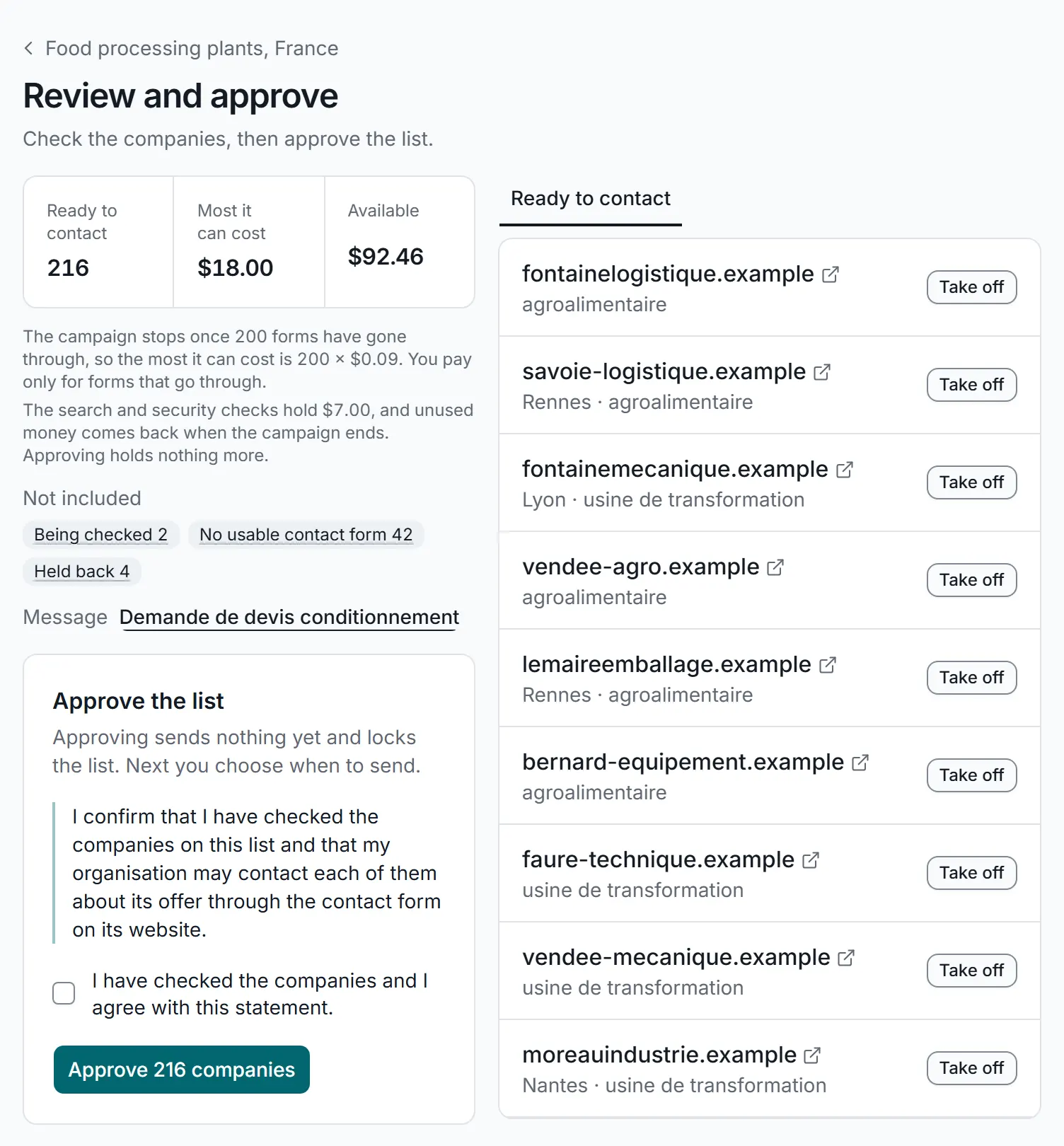
Before you approve, you see every company and the one message they all get. A real screen from the app, with sample data.
What to avoid
- Pretending. Do not suggest you have met, or that they asked to hear from you, when they did not.
- Pressure. No fake deadlines, no “last chance” and no guilt.
- Walls of text. Long paragraphs get skipped.
- Too many links. One link to your website is enough.
- Shouting. No whole words in capital letters and no rows of exclamation marks.
- The wrong companies. Only write to companies your offer really fits.
A checklist before you send
- The subject says what the message is about.
- The first line says who you are and why you are writing.
- It is short enough to read without scrolling.
- There is one clear ask.
- Your name, company, email and phone number are there.
- It reads well in the reader's language.
- It is true for every company on the list, with nothing left in brackets.
Want a starting point? Our contact form message examples show short messages for common goals, with notes on why each one works.