Is contact form outreach legal?
Companies put contact forms on their websites so people can get in touch. Whether your message is allowed depends on the country, on who you write to and on what you say. Here are the habits that keep outreach fair, what the app does to help, and what to check before you send.
$0.09 for each form that goes through. $10 covers about 111.
In short
- Write to businesses through the form on their own website
- Say who you are, and stop when a company asks you to
- Check the rules for the countries you send to
- Nothing is sent until you approve the list
General information, not legal advice.
Four habits that keep outreach fair
They do not replace checking the rules, but they keep your messages honest and easy to answer.
Use each company's own contact form
Write through the contact form a company put on its own website so people can get in touch.
Write to businesses about their business
Send messages that relate to what the company does. The app is for business use: do not use it to reach private people where that is not allowed.
Say who you are and how to reach you
Use your real name, your company and your contact details in every message. Never hide who a message is from.
Stop when a company asks you to
When a company asks you to stop, it goes on your do-not-contact list and is skipped in every campaign after that.
Our terms ask the same of everyone who sends. The full rules are in the terms of service.
What the app does to help
The app cannot tell you what is allowed in a country. It does make the careful way the easy way.
You approve every list
Nothing is sent until you check the companies and confirm that your organisation may contact each of them through its contact form.
One do-not-contact list for the whole account
Replies asking you to stop put the company on it, and you can add companies by hand. Listed companies are skipped in every campaign, including ones your own software starts.
Proof of every message that goes through
A picture of the filled-in form and of the page the site showed after sending, with the page address, date and time.
Your sender details on every message
Messages go out with the name, company and contact details you choose, so each company knows who is writing.
Sent in office hours, stopped any time
Messages go out during office hours in each company's country, and you can stop a campaign at any time.
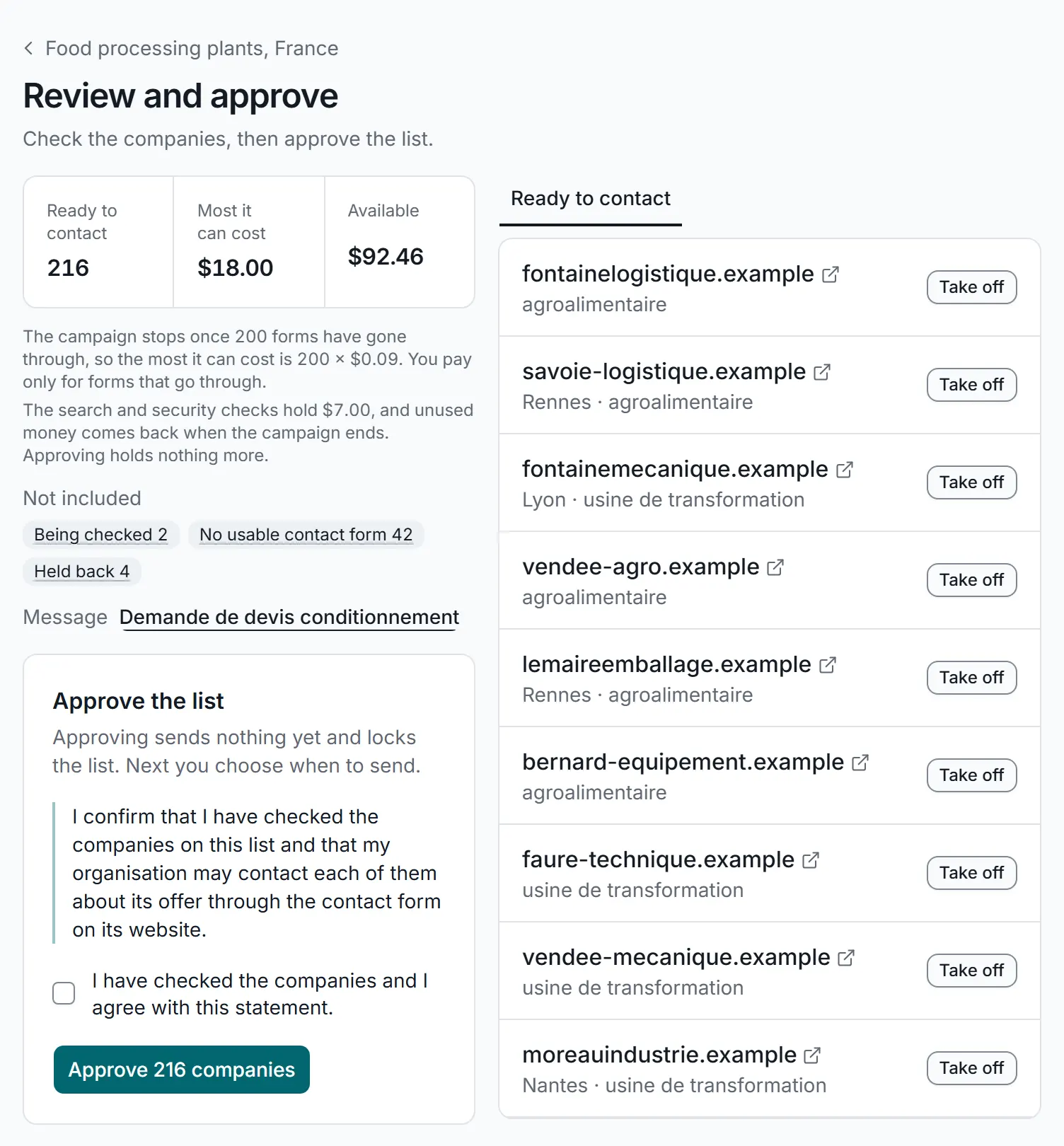
Before anything is sent, you confirm that your organisation may contact each company on the list.
What to check before you send
Whether a message is allowed can depend on three things: the rules where you are, the rules where the company is, and what the message says. Some countries have rules for marketing in general, some for email in particular, and some apply their email rules to other electronic messages too.
So the same campaign can be fine in one country and need more care in the next. Check each country on your list, and ask a lawyer if you are not sure.
Questions to ask for each country
- Do the rules cover messages sent through a website contact form, or only email?
- Do you need the company's consent before you send it advertising?
- Are sole traders and very small businesses treated like companies, or like private people?
- What must each message say about who you are and how to stop further messages?
- Do the company's website terms say how its contact form may be used?
- What do privacy rules say about the names, emails and phone numbers you collect and keep?
Where to take extra care: advertising
In some countries, unsolicited advertising sent through a company's contact form is treated the same way as unsolicited advertising email. There, sending it can need the company's consent first, even though the form is on its own website.
Check before you send
Find out how the countries on your list treat advertising sent through contact forms. If you are not sure, ask a lawyer who knows those rules.
Look at what your message is
A sales offer, a question to a supplier and a partnership idea may be seen differently. Check how the rules treat the message you plan to send.
Choose your countries
You pick the country when we find companies for you, and you can take any company off the list before you approve it. Leave out places where you are not sure.
Questions about the rules
Anything not covered here? Email us at hello@contactformoutreach.com.
Is contact form outreach legal?
It depends on the country, on who you write to and on what your message says. Some countries treat unsolicited advertising sent through a contact form like advertising email, which can need the company's consent first. Check the rules where the companies are, or ask a lawyer. This is general information, not legal advice.
Is this page legal advice?
No. It is general information to help you know what to ask. It does not describe the rules of any particular country, and it does not replace advice from a lawyer who knows the rules that apply to you.
Who is responsible for following the rules?
You are. Our terms ask everyone who sends to follow the laws that apply to them and to the companies they contact, including marketing, privacy and anti-spam rules in each country. The app helps with approving lists, a do-not-contact list and proof of every message, but it does not decide what is allowed where.
Can I write to private people through contact forms?
The app is for business use. Do not use it to contact private people where that is not allowed. It is made for messages to companies about their business.
What happens when a company asks me to stop?
Its reply is marked as a request to stop and the company goes on your do-not-contact list. Companies on that list are skipped in every campaign in your account, including campaigns your own software starts.
What about forms with a security check?
Some forms ask a security question before they send. A campaign only pays for help with those if you set an amount for it, and never spends more than that. A form that does not go through costs nothing.
Does the app check the rules for me?
No. You choose the companies, the countries and the message, and when you approve a list you confirm that your organisation may contact each company. The app does not decide whether a message is allowed in a country.
Start with a small, careful campaign
Top up from $10, enough for about 111 forms that go through. Check the rules for your countries, then approve the list when you are ready.